

Each issue we sit down with a core team member and chat about their work and objectives, views on mitigating climate change, and inside perspectives on the ETC’s work.
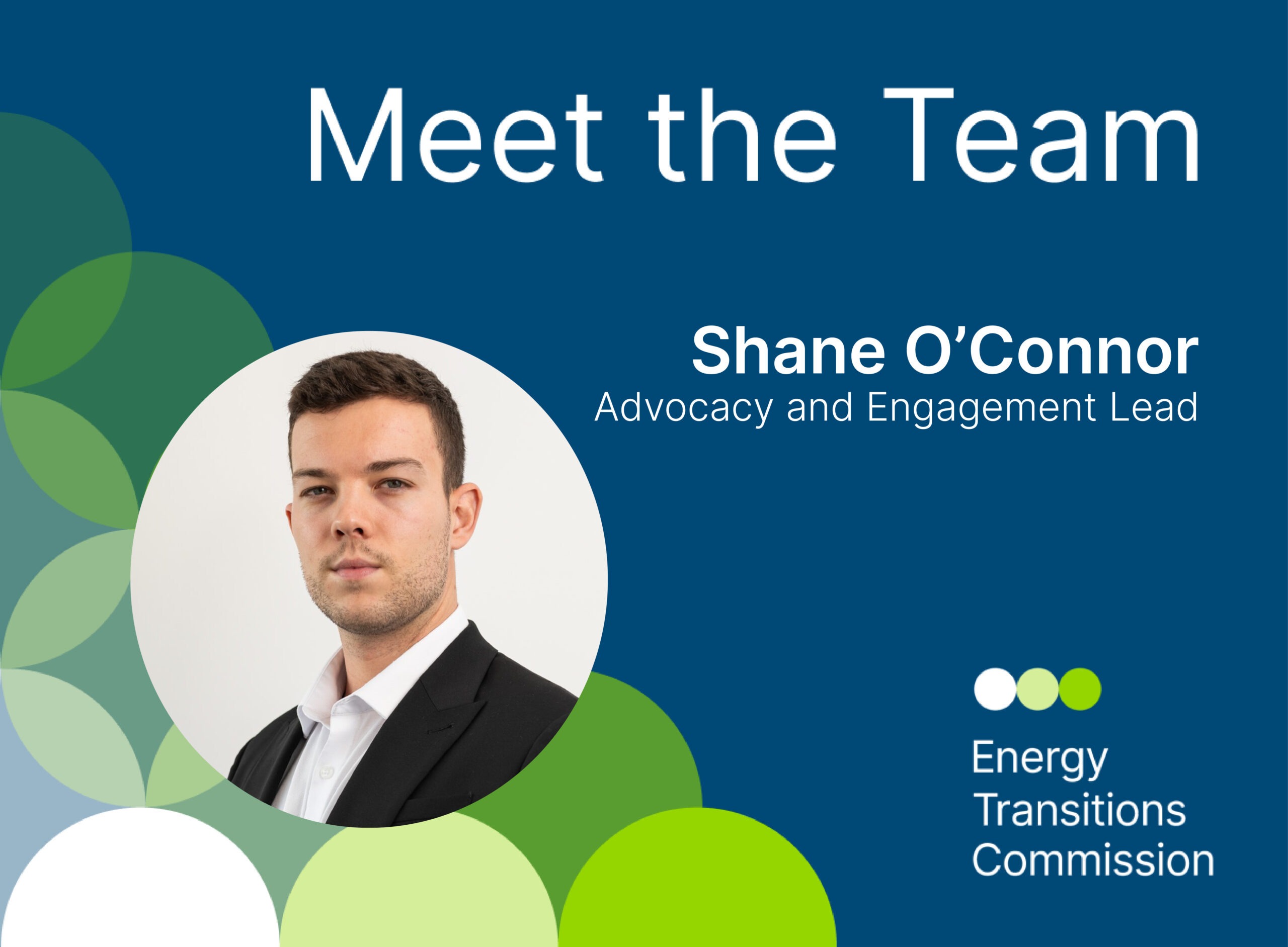
In this issue, we get to know Shane O’Connor, Advocacy and Engagement Lead at the Energy Transitions Commission. Shane moved into this role at the start of 2025, having previously led the ETC’s Barriers to Clean Electrification analytical programme. He has been instrumental in ETC’s work on Building Energy Security, Streamlining Planning and Permitting, Overcoming Turbulence in the Offshore Wind Sector, Building Grids Faster, and the recently published briefing on Long-distance interconnection , and supported broader efforts on Power Systems Transformation.

What made you join the ETC?
I was working in UK government Department for Business, Energy & Industrial Strategy as an industrial decarbonisation economic advisor prior to joining the ETC and in my first week someone handed me the ETC’s Mission Possible report as an excellent roadmap for the energy transition. The quality of the insights and charts were better than anything I’d seen to date, and really respected across the department. Shortly after that, the UK set its net-zero by 2050 target and I don’t think this would have been possible without the great content created by the ETC.
I was so impressed by the quality and breadth of analysis in Mission Possible and subsequent ETC reports that I wanted to join the team to maximise my personal impact and work more at the global level rather than at national government level. I’m glad that I now have had the chance to accelerate the transition right across the globe, amongst probably the best colleagues in the world.
What’s your proudest achievement to date at the ETC?
My proudest achievement to date is probably both publishing the Planning and Permitting insights briefing, and presenting these insights to senior members of the EU Commission, at the UK political party conferences, and to ETC members and experts from around the world to drive real policy change.
It was a really good piece of analysis with clear solution toolkits outlining how we can speed up the project development times of wind and solar. Since then, it’s been great to see some of those recommendations being picked up across the world and project development times start to accelerate. That is really rewarding to me. But it is still vitally important that we can and we must go a lot farther and faster in rolling out our solutions to continue reducing project development timelines.
What does the energy transition mean to you?
For me, it’s two things: freedom and opportunity. First, the energy transition gives us the freedom to have clean air, the freedom to have a habitable planet for ourselves and future generations. Each summer recently has felt hotter and hotter, and fighting climate change can help give people around the world the freedom to live safely from the exacerbated impacts of extremes of heat, floods and other climate-related events.
It also gives countries freedom through energy security. When I joined the ETC a few years ago, was there was a gas crisis going on and energy prices were spiking. My first task was to figure out what was causing that. It turned out Russia was restricting gas supplies to Europe months before the invasion of Ukraine to drive up energy prices and put themselves in a stronger negotiating position. Our analysis highlighted that if countries transitioned to higher shares of renewables and became less dependent on volatile and politically motivated fossil fuel markets, they could gain energy security and freedom to enact policies against the desires of hostile states.
It’s also an opportunity to have a more equitable energy system not dominated by returns to fossil fuel companies. It’s an opportunity for economic growth, particularly in developing sunbelt countries which are some of the countries who will be hit hardest by temperature and sea level rises, and who have been traditionally left behind. They can have dramatically cheaper power through the combination of solar and batteries.
What are you most excited about that’s coming up at the ETC?
At the start of this year I became the ETC’s Advocacy and Engagement Lead. To me, this was the next logical step following my work on the Barriers to Clean Electrification.
My colleagues and I have crunched the numbers and developed a sensible, streamlined solutions for by accelerating the energy transition as fast as reasonably possible. Now, I’m excited and looking forward to getting these solutions into the hands of policymakers who make the decisions, businesses who make the investments and build clean energy systems, and the public who advocate for the changes that need to happen.
I’m particularly looking forward to providing our insights to climate youth groups. In recent years, climate youth groups have done a great job getting themselves a seat at the table on the global stage. But they don’t have one common evidence base for energy transition statistics and analysis. I’m hoping we can help them pick up ETC’s evidence base and use it as a springboard for their great advocacy efforts across the world.
I’m also excited about the piece of work we’re doing on the economics of the transition, which I think will be really important. We’ve said for years the transition should only cost 1–2% of global GDP per year, but it’s becoming more apparent each year that the costs of inaction are in the tens of trillions. I’m looking forward to ETC laying out the evidence and making an even more compelling case for accelerating the transition.
On the pathway to net zero, what do you see as the biggest obstacle?
I think the biggest obstacle now is a lack of political will, and the extent of this differs quite heavily across countries. I believe that in general the public support the transition – we’ve seen recent surveys that show 86% of the global population believe the government should do more to fight climate change. But there is a form of miscommunication and disconnect between the public and policymakers.
It is important for the public’s wants to be communicated to policymakers and truly understood. This can help policymakers confidently make decisions that cut red tape to get clean energy generation capacity installed and infrastructure built faster. The recommendations highlighted in ETC reports to create the cheaper, cleaner power system of tomorrow increasingly align with what people around the world want. With public and policy alignment, then money and resources will follow.
What’s the best piece of advice that you received from an ETC colleague?
Adair’s words resonate with me most: there are lots of reasons to be sad in the current geopolitical environment – looking at the weather and temperature increases – but when you need some optimism, it’s really good to look at learning curves. The cost of solar has come down more than 90% in the last decade, and solar and batteries have declined by 50% in the past two years alone.
When Adair was head of the CCC 15 years ago, it was predicted these costs would only come down by about 30% in 2025 in the most favourable estimates. So the level of cost declines have well surpassed what was expected. Looking ahead to the next 15 years, not only will these trends continue – solar, wind and batteries will get even cheaper still – but a whole range of other technologies like white hydrogen (pure hydrogen found naturally in caverns) or thorium molten-salt reactors (next generation SMRs contained in a shipping container with excellent fuel economy) could take off and have a transformational effect on the pace and cost of the transition.
Learning curves of the old, and vast technological potential of the new give me more optimism that we can limit warming effectively, and do so in an economically profitable way that’s appealing to the broader electorate.