

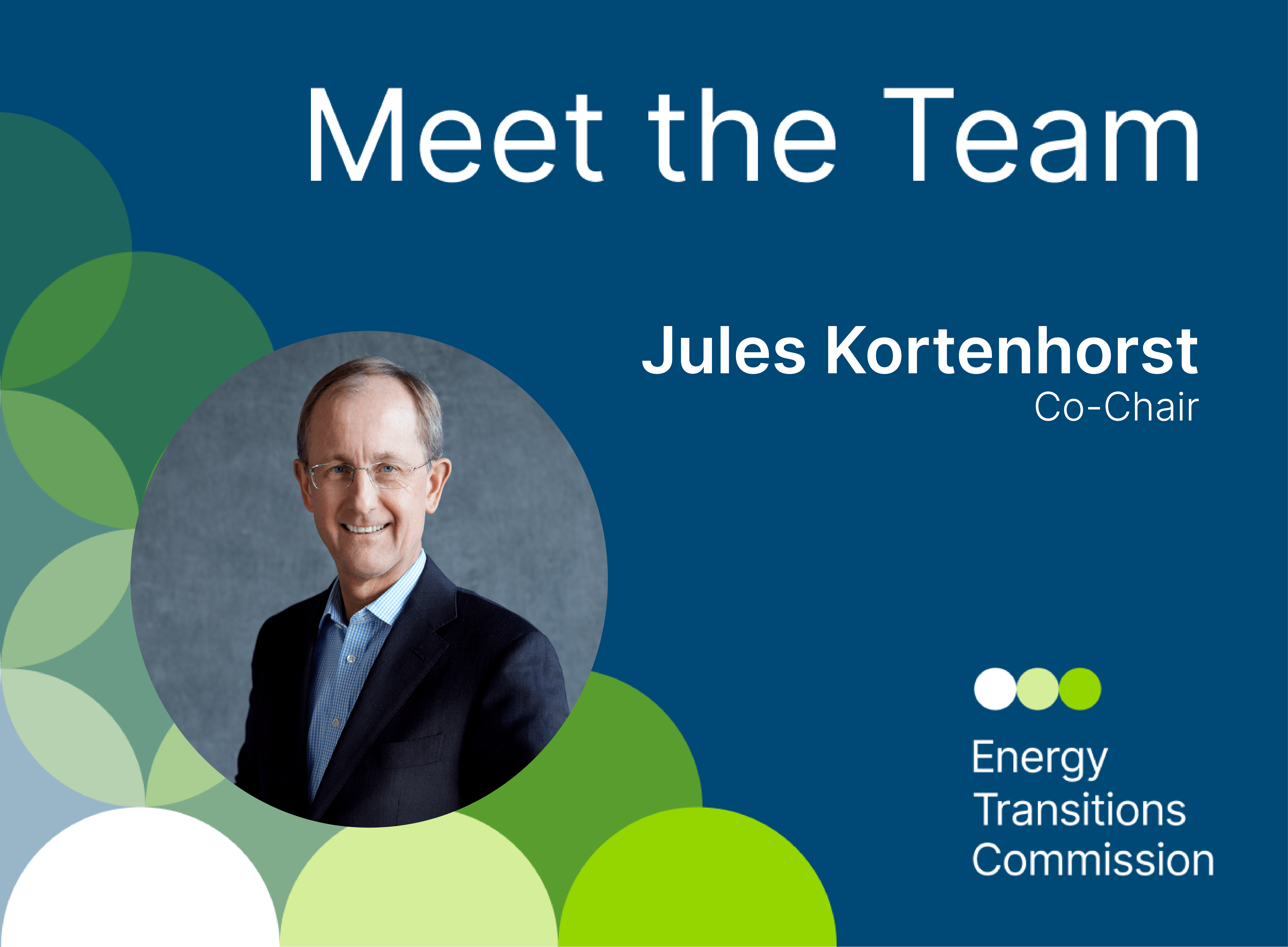
We are delighted that Jules Kortenhorst will re-join the ETC as Co-Chair effective Q1 2026, having been a founding Commissioner. He will join Adair Turner, who has led the ETC for the past decade and will continue to serve as Co-Chair.
Jules brings deep experience spanning energy, finance, and climate leadership – from serving as CEO of Rocky Mountain Institute and founding CEO of the European Climate Foundation, to his current role as CEO of Bridge Carbon, focused on mobilising climate finance in emerging economies. Jules spent the first twenty years of his career in the private sector including ten years at Shell.
In this issue, we get to know Jules better. We sat down with him to discuss his motivations, his views on the energy transition and climate mitigation, and his perspective on the ETC’s role in accelerating progress in a rapidly changing global context.
What drew you to the ETC?
Over the last 20 years, I have been deeply passionate about addressing climate change and it is very clear that the energy transition is a critical enabler of tackling climate change. For more than 10 years, the Energy Transitions Commission has increasingly made significant contributions to climate mitigation through its work, its analysis, the data, and the insights it has brought to the debate. It has shown that the energy transition will, over time, reduce the overall cost of our energy system, make energy more secure, and more sustainable. There are many reasons to cheer on the progress of the energy transition.
What do you see as the ETC’s most impactful achievement to date?
The debate on the energy transition inspires many passionate conversations, and sometimes confused or even contrarian points of view. ETC’s role in bringing fact-based, high-integrity analysis to that debate, and providing leaders in business, government, and civil society with deep insights grounded in robust analysis and facts, is therefore a very powerful and important contribution.
What do you see as the biggest obstacle on the journey to net zero?
In some ways, the biggest obstacle is the opposite of what I just mentioned: the sheer amount of confusion and uncertainty. If you are a government minister in Southeast Asia considering whether your next energy investment should be a coal plant, a solar plant, or an LNG plant, you receive confusing inputs from various stakeholders about the best solution.
Similarly, business leaders assessing the future trajectory of energy technologies are confronted with many conflicting perspectives. Bringing fact-based analysis and insights to that debate is crucial, because it overcomes what I believe is one of the biggest stumbling blocks.
What are you most excited about that’s coming up with the ETC?
I have been part of the ETC right from its founding. It has always been incredibly inspiring to work with very passionate, wickedly smart people who care deeply about this subject.
What I am most looking forward to is engaging with the amazing team at the Energy Transitions Commission, with the Commissioners, the members, and the broader stakeholder community. There will be robust debate, and I will learn, as will many others around me.
What is the one necessary change you feel most personally passionate about in the transition journey?
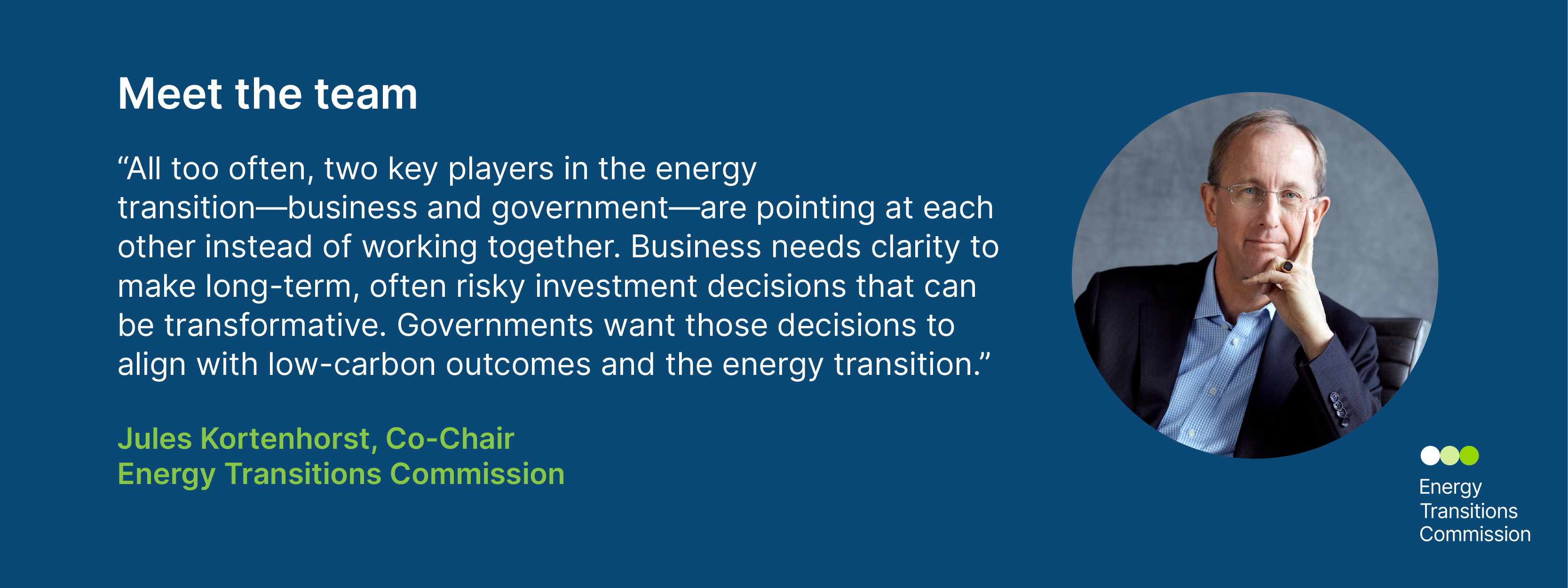
All too often, two key players in the energy transition—business and government—are pointing at each other instead of working together. Business needs clarity to make long-term, often risky investment decisions that can be transformative. Governments want those decisions to align with low-carbon outcomes and the energy transition.
If these two groups work better together to create policy frameworks that enable business leaders to make the right decisions, we would make a huge step forward. Those policy decisions must be informed by good analysis and insight, hence the role of the ETC, but also by constructive dialogue with stakeholders, guided by the goal of reaching net zero by 2050 and aligning with the Paris Agreement. Well-informed dialogue is a critical requirement we must meet.
What keeps you optimistic on challenging days?
What makes me optimistic is also a striking reflection on our work over the past 10 years: innovation often starts slowly, then scales far more rapidly than expected. Many of us are familiar with the famous graph where solar forecasts remain flat while reality follows a clear S-curve.
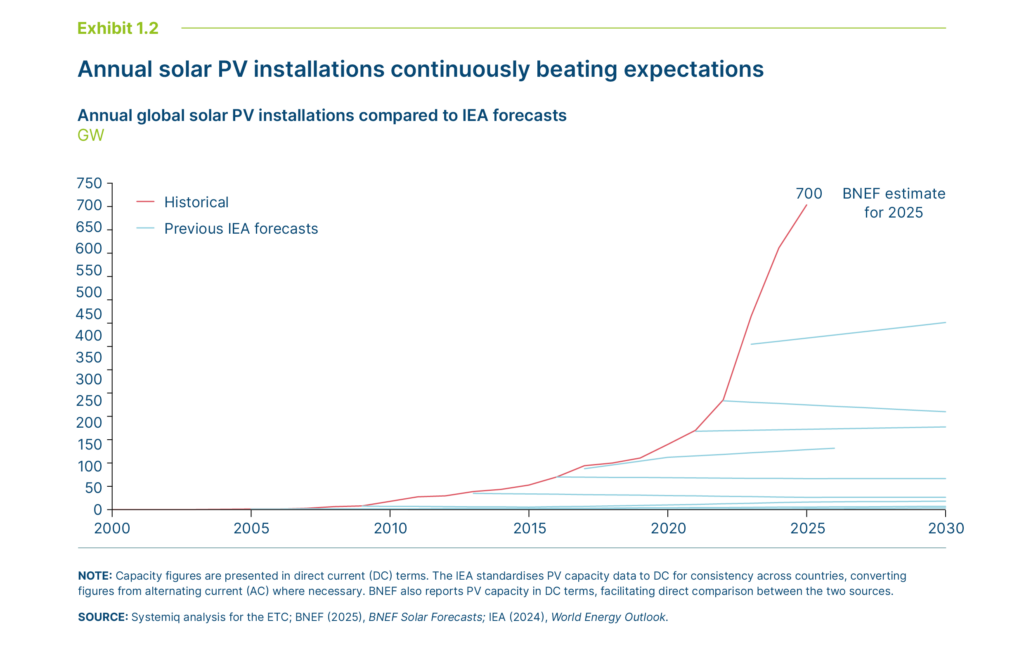
Exhibit 1.2 from ETC (2025), Power Systems Transformation: Delivering Competitive, Resilient Electricity in High-Renewable Systems
Many energy transition technologies are now scaling on the steep part of that S-curve. Those who assume tomorrow will look like yesterday are missing something fundamental. This is hopeful: the technologies we need are scaling rapidly, in some cases – such as solar and battery storage – even faster than Paris-aligned deployment pathways.
That said, there are sectors, particularly hard-to-abate ones, where we are not yet on those steep curves, and there is still plenty of work to do.
What do political and business leaders still underestimate about the energy transition?
The most powerful underlying fact is the learning rate of technologies like solar, batteries, and wind. Every time globally installed capacity doubles, costs fall by a fairly fixed percentage – over 20% for solar and batteries, and close to 15% for wind turbines.
Much like Moore’s Law in computing, these learning curves are unrelenting and drive exponential scale-up. Many leaders still do not fully appreciate how the compounding nature of these S-curves will help us address climate change.
What makes ETC’s approach different from other climate organisations?
There are two things that make the ETC’s contribution unique. First, it brings together 50 diverse members with differing perspectives. The debates can be intense, but that leads to better insights, stronger conclusions, and higher-quality work.
Second, the ETC is pragmatic while at the same time deeply committed to the goals of the Paris Agreement. We are committed to net zero by 2050, to well below 2°C, and to a fair and equitable transition. Ideology does not dominate the debate. The analysis is fact-based and, at times, hard-nosed business analysis, leading to better insights and advice.
What is one misconception about net zero you wish would disappear?
Some fossil fuel incumbents – outside of the Commission – now believe that reaching net zero by mid-century is either technologically impossible or prohibitively expensive. The Commission’s work, and broader real-world experience, especially in electricity, shows that innovation can scale far faster than in past energy transitions.
The path to net zero is not easy, but it is technologically feasible and likely cheaper than many expect. The belief that it must be slow, impossibly hard, and extremely expensive reflects past transitions—not the electro-technical revolution now underway.
Outside of work, what helps you reset or recharge?
I am fortunate to live in the foothills of the Rocky Mountains in Boulder, Colorado. There is no greater joy than hiking in these beautiful mountains with my wife, or spending time with my children and grandchild when they visit. There is no stronger motivation for this work than knowing we are doing it for future generations – to be good stewards of the planet and leave it in a better state than we found it.