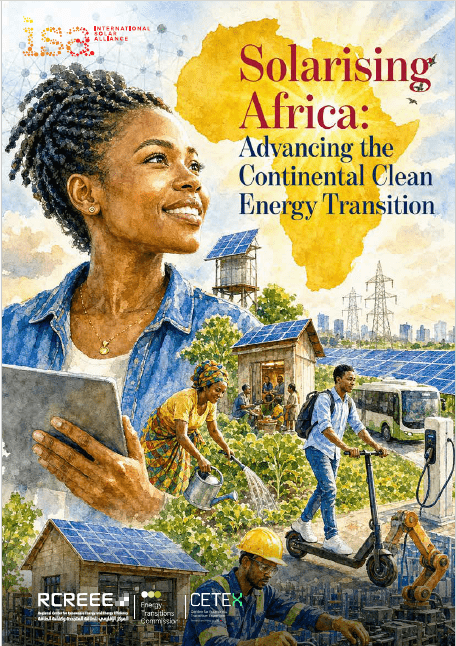


Solarising Africa: Advancing the Continental Clean Energy Transition
September 2026
Africa possesses 60% of the world’s best solar resources, yet only 600 million people lack reliable electricity access and capture just 2% of global solar investment. The cost is measurable: 2-4% of GDP lost annually to power unreliability.
The International Solar Alliance’s Solarising Africa report, with contributions from the Energy Transitions Commission, maps the challenges to unlocking deployment at scale: policy design, financing structures, institutions and skills.
Now is the time to act. Solar costs have fallen 67% since 2015. 48 countries have endorsed the Dar es Salaam Energy Declaration. 35 governments published National Energy Compacts under Mission 300, embedding 2030 targets across energy access, clean cooking, renewables share and private capital. For the first time, African demand is written down, comparable across borders and formally monitored.
The report prescribes five priorities that cut across all markets: policy certainty before project finance; affordable capital at scale; design for productive use; modernised utilities; and proven African solutions scaled through structured peer exchange, matched by market type.
The destination is 1,000 GW of solar capacity by 2050. The journey unfolds in three phases: foundation (2030), scale (2040), consolidate (2050). This report sets out what making that work looks like across distributed renewable energy, agricultural electrification, e-mobility and utility-scale solar.
This is a blueprint for governments, regulators, utilities and financiers ready to move from commitments made to delivery.