

Unlocking Solar at Scale: How Agrivoltaics Overcome Land Constraints in India’s Energy Transition
June 2026
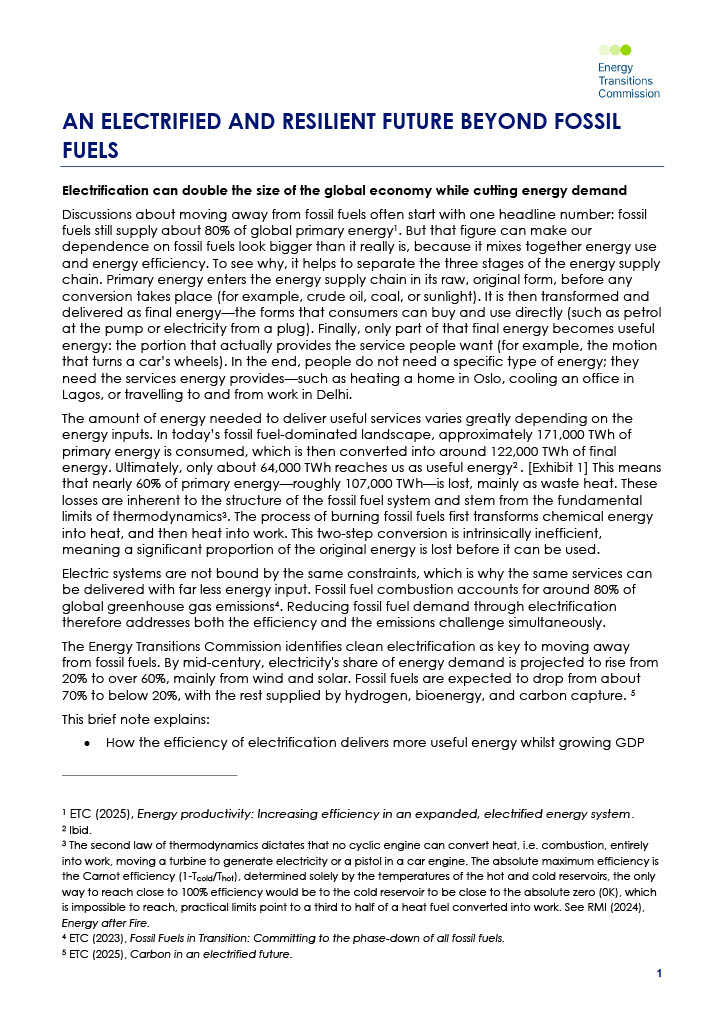
Analysis by the Energy Transitions Commission (ETC) and The Energy and Resources Institute (TERI), supported by the Global Energy Alliance for People and Planet (GEAPP), finds that land availability is not a binding constraint on India’s solar expansion when agrivoltaics (AgriPV) is considered. AgriPV is the co-location of solar panels and agricultural production. It enables solar generation on productive farmland without displacing crops or grazing, and without compromising local food production or livelihoods.
- 47.5 million hectares of cropland, around 30% of India’s total cropland, are technically suitable for AgriPV after applying environmental and technical screening criteria.
- A high-potential deployment scenario suggests that AgriPV on cropland alone could generate around 12,775 TWh of electricity annually, more than twice India’s projected 2050 electricity demand.
- When combined with grazing land and other solar opportunities, total solar generation potential could reach around 27,000 TWh per year.
Evidence from operational pilot projects shows that:
- Leafy vegetables and fruits can achieve yield increases of 10–20% under partial shading.
- Some crops experience lower yields but improved quality, enabling higher market prices and supporting farmer incomes.
- Water savings average around 30%, with some sites achieving 30–50% savings, alongside improved soil moisture and reduced heat stress.
- Grazing and livestock systems are also compatible with appropriately designed AgriPV installations.
Scaling solar in India is therefore not constrained by land scarcity. Realising the potential opportunity will require distribution-level grid capacity, clear policy frameworks, and bankable financing structures to keep pace with India’s growing electricity demand.
Addressing these unlocks a deployment pathway that is not unique to India: AgriPV offers a proven template for other solar-rich regions facing the same constraints, delivering clean energy at scale without compromising food production or farmer livelihoods.
Related publications