


This section highlights key graphs from our analysis, outlining the ETC’s positioning on key sustainability topics. Our charts are one of the many ways our thought leadership shapes debate around the complex subject of the energy transition. The chart below is from our new report, Power Systems Transformation: Delivering Competitive, Resilient Electricity in High-Renewable Systems.
How much would clean power systems cost compared to current power prices?
A new ETC analysis suggests that future electricity systems based on high-shares of wind and solar could generate and deliver power at costs comparative to or even lower than today. This insight comes from modelling the full system costs of clean electricity, which means not just the cost of generating the power, but also the “balancing” needed when the sun isn’t shining or the wind isn’t blowing, as well as the cost of transmission and distribution.
The chart compares today’s average wholesale prices with estimated costs for clean power systems in 2050 across four countries representing regional archetypes: low-latitude region – India, mixed climate – China, Mediterranean climate – Spain, and high-latitude region – the UK.
What is behind these numbers?
The analysis uses simplified but illustrative assumptions to help compare different national contexts:
- The model assumes that 100% clean power comes from wind and solar, with no nuclear, hydro, or fossil fuels. In reality, most future systems will be more diverse.
- To reflect future technology costs, the systems are modelled as if they were entirely built in 2050 using projected prices for wind, solar, batteries, and hydrogen-based backup.
- Short-term energy storage is mostly done with batteries, while long-duration backup (for days or weeks of low renewables) is assumed to come from hydrogen burned in gas turbines. Other cheaper balancing options, like demand-side flexibility or expanded grid connections, are not included here, meaning real-world costs could be lower.
The analysis shows that sunny regions like India, China and Spain are likely to benefit from low-cost solar paired with batteries, making clean power cheaper and simpler to balance. While more complex systems are required in windier, northern countries. The UK’s higher projected costs reflect the need for more long-term storage and backup in places where sunshine is less reliable.
ETC’s simplified results are supported by models by other organisations, that simulate how electricity supply and demand would realistically balance in a year, ideally in half-hour or shorter increments. While actual system design will vary by country, the overall conclusion is clear: it is possible to build reliable, renewables-based systems at a cost that’s competitive or even cheaper than today’s fossil-fuel based electricity.
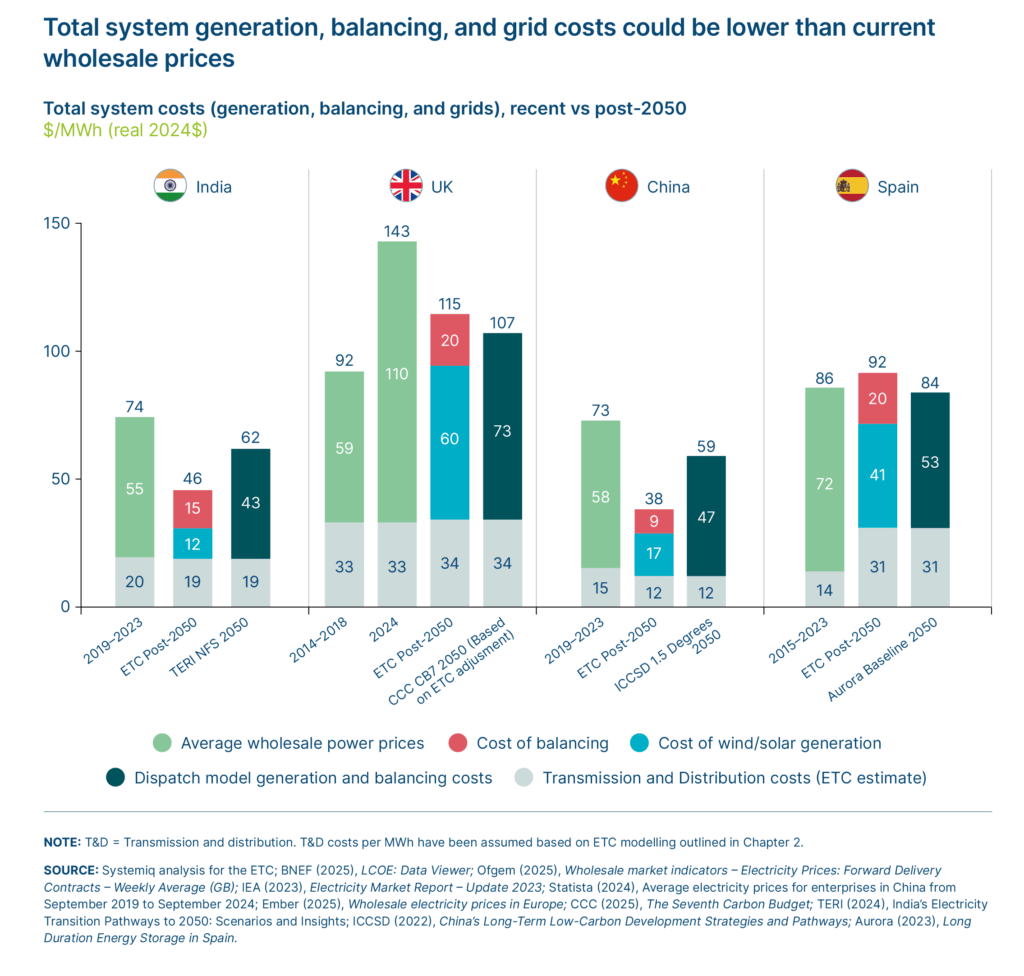
This chart is Exhibit 3.1 from our 2025 report, Power Systems Transformation: Delivering Competitive, Resilient Electricity in High-Renewable Systems.
If you would like to reproduce this chart, please let us know.
Interested in receiving these insights in your inbox? Click here to sign up for our mailing list.