


This section highlights key graphs from our analysis, outlining the ETC’s positioning on key sustainability topics. Our charts are one of the many ways our thought leadership shapes debate around the complex subject of the energy transition. The chart below is from our latest major report, Carbon In an Electrified Future: Technologies, trade-offs and pathways.
Managing Carbon in an Electrified Net-Zero Economy
When burned as fuels or released at the end of a product’s life, this carbon becomes carbon dioxide (CO2). Reducing carbon dioxide emissions therefore requires cutting how much carbon is used and carefully managing the carbon that remains in the system.
Our report, Carbon in an Electrified Future, examines how carbon demand changes in a net-zero economy shaped by large-scale electrification. As electricity replaces fossil fuels across much of transport, buildings and industry, total global carbon demand could fall from 11.5 Gt today to 3.3–4.8 Gt by mid-century. However, the extent depends on how technologies, costs, and markets evolve.
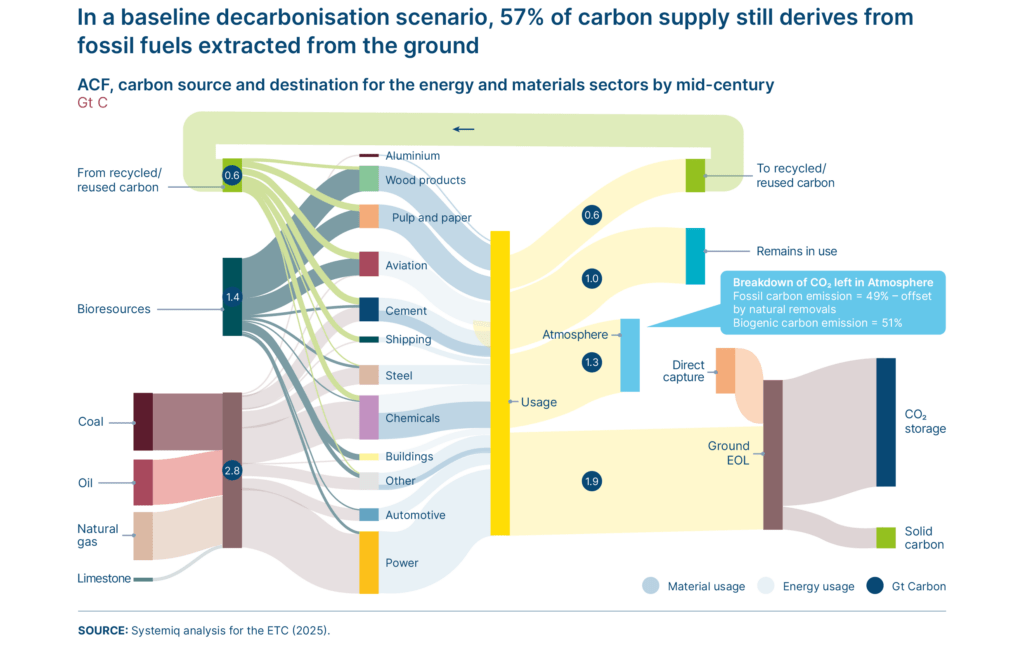
One possible pathway is illustrated in the chart below (Exhibit 6.1 in the main report). It represents the ETC’s “Accelerated but Clearly Feasible” (ACF) scenario, reflecting steady progress towards a highly-electrified net-zero future using technologies that are already available or close to commercial scale. It does not assume rapid breakthroughs or unrealistically high deployment rates. In this pathway, total carbon use falls by around 60% by 2050, driven by electrification, efficiency, and reduced fossil fuel demand. Even so, carbon remains essential for hard-to-electrify sectors such as aviation, shipping, cement, and chemicals.
In this scenario, recycled and reused carbon rises from 0.2 Gt today to 0.6 Gt by 2050, but a significant amount of new or “primary” carbon is still required, around 4.2 Gt, which would be met by 1.4 Gt of sustainable bioresources and 2.8 Gt of fossil carbon. Any remaining use of fossil carbon must be paired with carbon capture and permanent end-of-life storage to avoid emissions.
Treating carbon as a managed resource is critical to reduce key transition risks. It helps avoid building systems that depend on more carbon than a net-zero economy ultimately needs, limits unnecessary pressure on land and natural ecosystems, and reduces the risk of inefficient investment in fuels and infrastructure that may not be compatible with long-term climate goals. Carbon stewardship, treating the remaining carbon as a finite resource with the same discipline as we treat energy, land and water, complements electrification in delivering a resilient and cost-effective path to net-zero.
 This chart is Exhibit 7.3 from our 2025 report, Carbon In an Electrified Future: Technologies, trade-offs and pathways.
If you would like to reproduce this chart, please contact us.
Interested in receiving these insights in your inbox? Click here to sign up for our newsletter mailing list.