

Power Systems Transformation: Delivering Competitive, Resilient Electricity in High-Renewable Systems
July 2025
Power Systems Transformation: Delivering Competitive, Resilient Electricity in High-Renewable Systems, sets out that global power systems dominated by wind and solar generation can reliably deliver electricity at costs comparable to or lower than today’s fossil fuel-based power systems in most parts of the world. Many countries can operate power systems with 70% or more electricity from wind and solar, using proven technologies available today, like batteries, other energy storage, long-distance transmission, and flexible energy use.
Scaling Grids and Demand Flexibility to Accelerate the Energy Transition
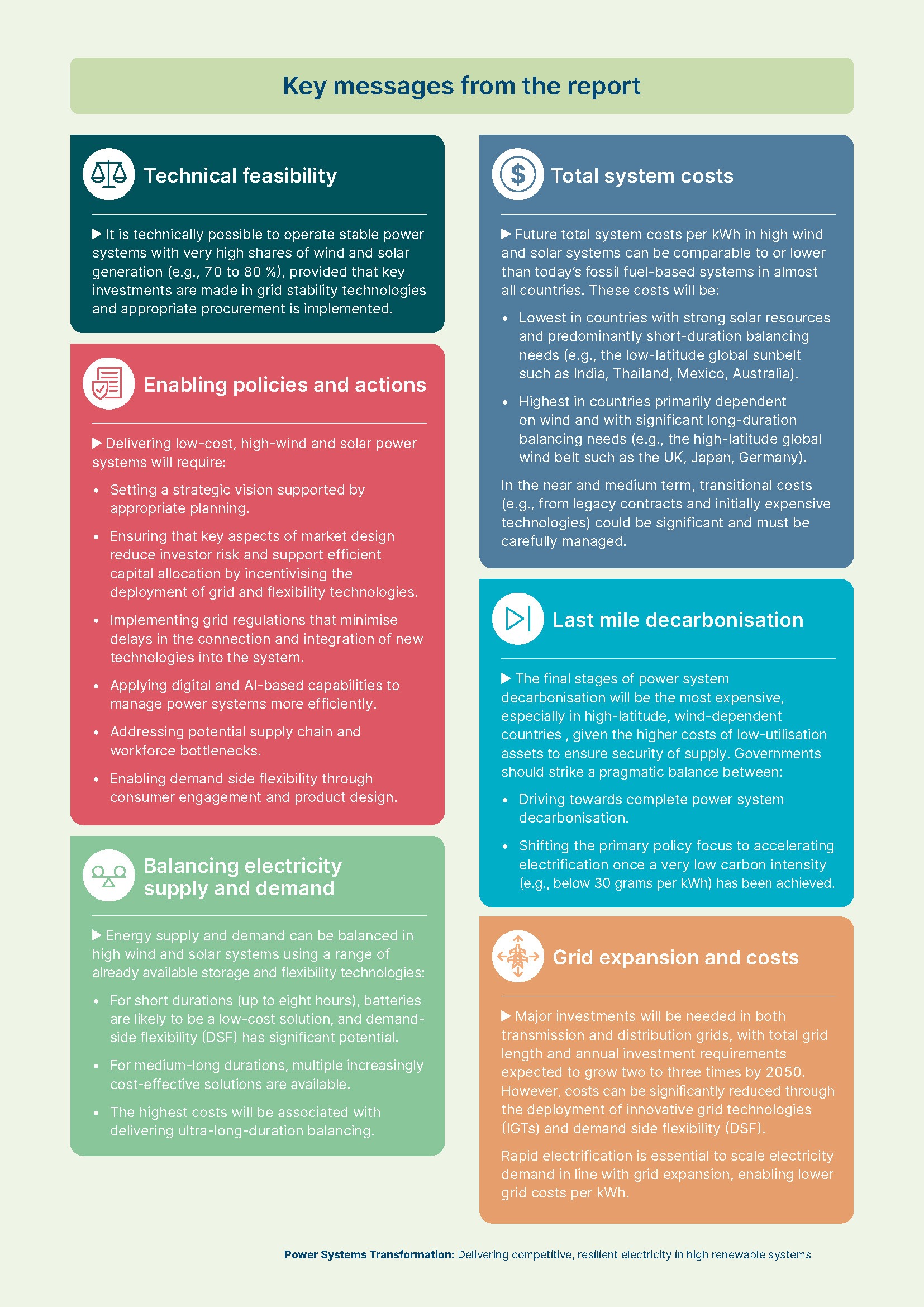
It is technically possible for wind and solar-dominant systems to be stable and resilient with the right mix of balancing and grid technologies. Delivering low-cost, high variable renewable energy power systems will require strategic vision and planning, including market reform to put all technologies on a level playing field, grid modernisation enabled by innovative technologies, supply chain development strategies and customer engagement.
There are significant regional opportunities:
- “Sun belt” countries – including India, Mexico, and much of Africa – are best-positioned to cut power system costs by transitioning to low-cost, solar-led systems, which mainly require day-night balancing.
- “Wind belt” countries – such as the UK, Germany, and Canada – that rely on higher shares of wind face higher balancing costs, but can still achieve affordable, stable systems through smart policy and innovation.
Download the report
Download
Key findings:
It is technically possible for wind and solar-dominant systems to be stable and resilient with the right mix of balancing and grid technologies. These systems are no more likely to experience blackouts than thermal generation-dominated systems.
High wind and solar systems can be competitive with today’s wholesale prices and grid costs. Sunbelt countries could see costs more than halve to $30-$40/MWh by 2050. Wind-dependent country costs (e.g., UK) are higher, but in the future could be comparable to current levels and below the cost of a fossil fuel system.
The “last mile” of decarbonisation will be the most expensive, particularly in countries which need ultra-long duration balancing to meet seasonal variations in supply and demand. Once countries have reached very low levels of carbon intensity (e.g. less than 50g per kWh), electrification is more important than rapid last-mile decarbonisation.
Up to 30% of all global power demand could be time-shifted through demand-side flexibility. This requires the development of dynamic pricing and the use of smart management technologies.
Grid costs per kWh can be kept stable. Total global grid length will need to more than double by 2050, reaching around 150–200 million km. Annual grid investment could rise from $370 billion in 2024, peaking at $870 billion in the 2030s. However, ~35% of grid expansion costs (equivalent to $1.3 trillion in Europe*) could be avoided between now and 2050 through the usage of innovative grid technologies.
Delivering low-cost, high variable renewable energy power systems will require strategic vision and planning, including market reform to put all technologies on a level playing field, grid modernisation enabled by innovative technologies, supply chain development strategies and customer engagement.
Related publications