



6th November 2026
Mr Murat Kurum
COP31 President and Minister of Environment, Urbanisation and Climate Change, Türkiye
Mr Chris Bowen
President of Negotiations for COP31 and Minister for Climate Change and Energy, Australia
Dear President Kurum and President Bowen,
Subject: Still vital, still possible: how governments and businesses can work together to limit global warming
The Energy Transitions Commission (ETC), a global coalition of leaders in support of the Paris climate objective of limiting global warming to well below 2°C and ideally to 1.5°C, urges the Presidency, in light of our new analysis, to act on clean electrification and the hard to electrify sectors (steel, cement, aluminum, chemicals, aviation and shipping). Our analysis shows it is essential and still possible to limit peak global warming to well below 2ºC, minimising the overshoot beyond 1.5ºC, and thereby preserving the potential to return to 1.5ºC by 2100. This fight is still vital, and still possible.
At the United Nations Climate Change Conference of 2015 (COP21), in Paris, the world committed to hold global warming to well below 2°C and pursuing efforts towards 1.5°C. COP21 initiated an ambition loop of progress: commitments turned into policies, policies turned into real economy change, and that change gave countries and companies the confidence to commit to further action. Because of this, and driven by dramatic falls in the costs of solar, wind, batteries and electric vehicles over the past decade, projections of future warming have fallen from 3.6°C to 2.6°C. However, the window of opportunity to limit global warming is narrowing. As the latest United Nations Environment Programme (UNEP) report, “Emissions Gap Report 2026: The Point of Return”, makes clear, it is now inevitable that warming will exceed 1.5°C over the next three decades, and UNEP’s “lowest possible” overshoot scenario now projects peak warming of about 1.7-1.8°C around mid-century.
The world faces a polycrisis, with artificial intelligence driving power demand faster than grids can expand[1], disruption to oil and gas flows threatening energy security, and wildfires, floods and storms damaging crops, infrastructure and livelihoods. Climate impacts and climate action act as connecting threads between all these events, which no country can resolve alone. Against this background, there are many voices now arguing that the Paris climate objectives are unachievable.
The ETC disagrees: we believe that accepting warming above 2ºC would cause immense harm for human welfare and would represent an irresponsible abandonment of the Paris target. If accepted, the proposal that we should weaken the Paris targets would undermine both public policies as well as company and financial institution commitments.
We believe it is still vital and possible to keep peak global warming well below 2°C and to preserve the potential to return to 1.5ºC by 2100. By making this clear we want to support COP31 in reigniting the flywheel of progress that can make it happen. The ETC has therefore conducted analysis to identify the actions needed to achieve that objective and to keep open the potential of returning to 1.5°C of warming by the end of the century. A report on the full analysis is published alongside this letter and shows how clean electrification and action in the hard-to-electrify sectors are the two biggest opportunities to achieve our shared objectives.
Methodology
To identify the actions required to keep global warming well below 2°C, we compared the emission levels that would result, by region and sector, in two scenarios:
- A “Least-cost economics scenario”, which assumes no further policy changes from today and in which new technologies are only adopted if and when they are cost competitive. This would result in about 1900 Gt of CO2 emissions between now and 2100 and warming of +2.6°C by that date.
- A scenario in which countries achieve net zero emissions around mid-century. This would result in at least 500-650 Gt of CO2 emissions between now and 2100 and warming of around +1.8°C in 2050 and 2100.
Findings
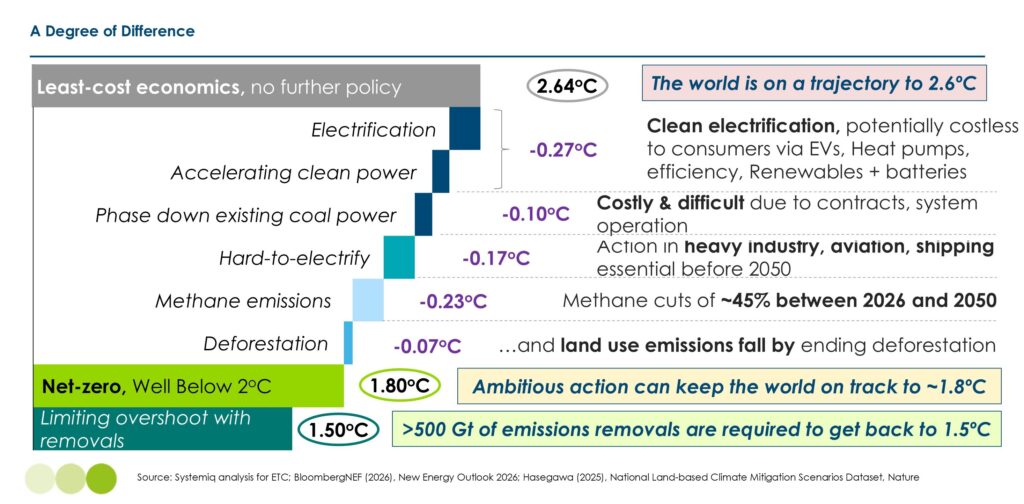
The exhibit below illustrates our key findings.
Limiting global warming to well below 2°C will require:
- Turbo charging clean electrification, with all power systems almost entirely decarbonised by mid-century and with electricity meeting over 50% of global final energy demand versus ~20% today. This alone could limit global temperature to +2.3°C, and much of this reduction can be achieved at very low or negative cost, provided the right incentives are in place to accelerate technological progress and cost reductions.
- Running down existing coal generation faster than the least cost scenario would deliver. Coal generation would fall from a third of current global generation to less than 5% by 2050, delivering a further reduction of ~0.1°C. This rundown will not be costless, so it will only occur if some combination of governments or private sector organisations is willing to bear some cost.
- Decarbonising the hard to electrify sectors, namely heavy industry, aviation and shipping, by mid-century. This could deliver another ~0.2°C decrease in eventual warming. Decarbonisation in these sectors entails a green cost premium, so it will only occur if countries introduce carbon pricing or equivalent regulation.
- Reducing annual methane emissions by around 45% by 2050, which could deliver a further 0.2°C temperature reduction. This requires a major (for example 90%) reduction in emissions from fossil fuel production and processing, much of which will occur automatically as clean electrification reduces fossil fuel use, together with major reductions in methane emissions from agriculture and waste, eventually reaching over 50% versus a business as usual level.
- Stopping deforestation by 2035.[1] Deforestation currently accounts for 4 Gt of annual CO2 Ending it would deliver a further temperature reduction of ~0.07°C versus the “Today’s least cost economics scenario”, which already assumes deforestation emissions falling to 2.8 Gt by 2050. Achieving this, together with agricultural methane reductions, will likely require significant reductions in red meat consumption.
What COP31 needs to focus on
Our analysis shows that clean electrification is the single most important priority, and that much of it can be achieved at very low or negative cost. Yet on its own it can only limit eventual global warming to around +2.3 to 2.4°C. It is therefore essential to deliver all of the actions described to limit global warming to well below 2°C. This will require multiple policies across all sectors and defines the required agenda for COPs going forward. For COP31 in Türkiye, the ETC recommends two key priorities, and asks the Presidency to place them at the centre of the COP31 outcome:
- Accelerate clean electrification: support the 35% electrification by 2035 target and develop country strategies to deliver on this goal.
- Act on hard-to-electrify sectors: commit globally to faster decarbonisation in cement, steel, chemicals, aviation and shipping, including through the spread of strong carbon prices.
Together these priorities start the flywheel on two fronts: one builds on existing momentum, and the other creates the policy signal where momentum is missing.
These actions together would make it still possible to limit global warming to 1.8°C. To return to 1.5°C by 2100 would in addition require that the world achieve at least 500-650 Gt of CO2 removals later in the century. This will require a global agreement on how to pay for these removals.
The ETC wants COP31 to succeed in accelerating the climate ambition loop and will keep convening corporate and financial institution leaders behind accelerating clean electrification and acting on hard to electrify sector priorities all the way to COP32.
Yours sincerely,
| Lord Adair Turner
Co-Chair, Energy Transitions Commission |
Jules Kortenhorst
Co-Chair, Energy Transitions Commission |
| Arun Sharma
Group Head for Sustainability and Climate Change, Adani Green Energy Limited |
Alan Thomson
Global Strategic Energy Programme Director, Arup |
| Nigel Topping
Co-CEO Ambition Loop, Chair UK Climate Change Committee |
Naoko Ishii
Director, Center for Global Commons |
| Lei Zhang
CEO, Envision Group |
Zhaoyuan Xu
Deputy Director General of the Industrial Economic Research Department of DRC |
| Nicholas Stern
IG Patel Professor of Economics and Government, Grantham Institute – LSE |
Laurence Tubiana
CEO, European Climate Foundation |
| Matt Gorman
Sustainability and Carbon Director, Heathrow Airport |
Assad Razzouk
CEO, Gurin Energy |
| Ian Simm
Chief Executive, Impax Asset Management |
Rohitesh Dhawan
CEO, ICMM |
| Rob Trezona
General Partner, Climate, Kembara VC |
Shaun Kingsbury
Chief Investment Officer, Just Climate |
| Thomas Hohne-Sparborth
Head of Sustainability Research, Lombard Odier |
Carl Moxley
Group Climate Director, L&G Group plc |
| Greg Jackson
CEO, Octopus Energy Group |
Faustine Delasalle
CEO, Mission Possible Partnership |
| Jon Creyts
CEO, Rocky Mountain Institute |
Matt Phillips
CEO, Pooled Fund on International Energy |
| Jean-Pascal Tricoire
Chairman, Schneider Electric |
Simon Thompson
Senior Advisor, Rothschild |
| Martin Pibworth
CEO, SSE |
Bradley Andrews
CEO, SLR Consulting |
| Chacko Thomas
Group Chief Sustainability Officer, Tata Sons |
Jamie Choi
CEO, Tara Climate Foundation |
| Vibha Dhawan
Director General, The Energy & Resources Institute |
Rajiv Mangal
Vice President Safety, Health & Sustainability, Tata Steel |
| Andreas Regnell
SVP Strategic Development, Vattenfall AB |
Bruce Lourie
Chair, Transition Accelerator |
| Maria Mendiluce
CEO, We Mean Business Coalition |
Lars Johansson
Head of Truck Technology, Volvo |
| Nick Wayth
Global Director, World Resources Institute, Polsky Center for the Global Energy Transition |
The Energy Transitions Commission is a global coalition of leaders from across the energy landscape committed to achieving net-zero emissions by mid-century, in line with the Paris climate objective of limiting global warming to well below 2°C and ideally to 1.5°C. The ETC’s analysis in this letter is based on its Knowledge Partner Bloomberg New Energy Finance’s New Energy Outlook (2026).
[1] IEA (2026) Key Questions on Energy and AI
[2] Conservative analytical assumption.
