
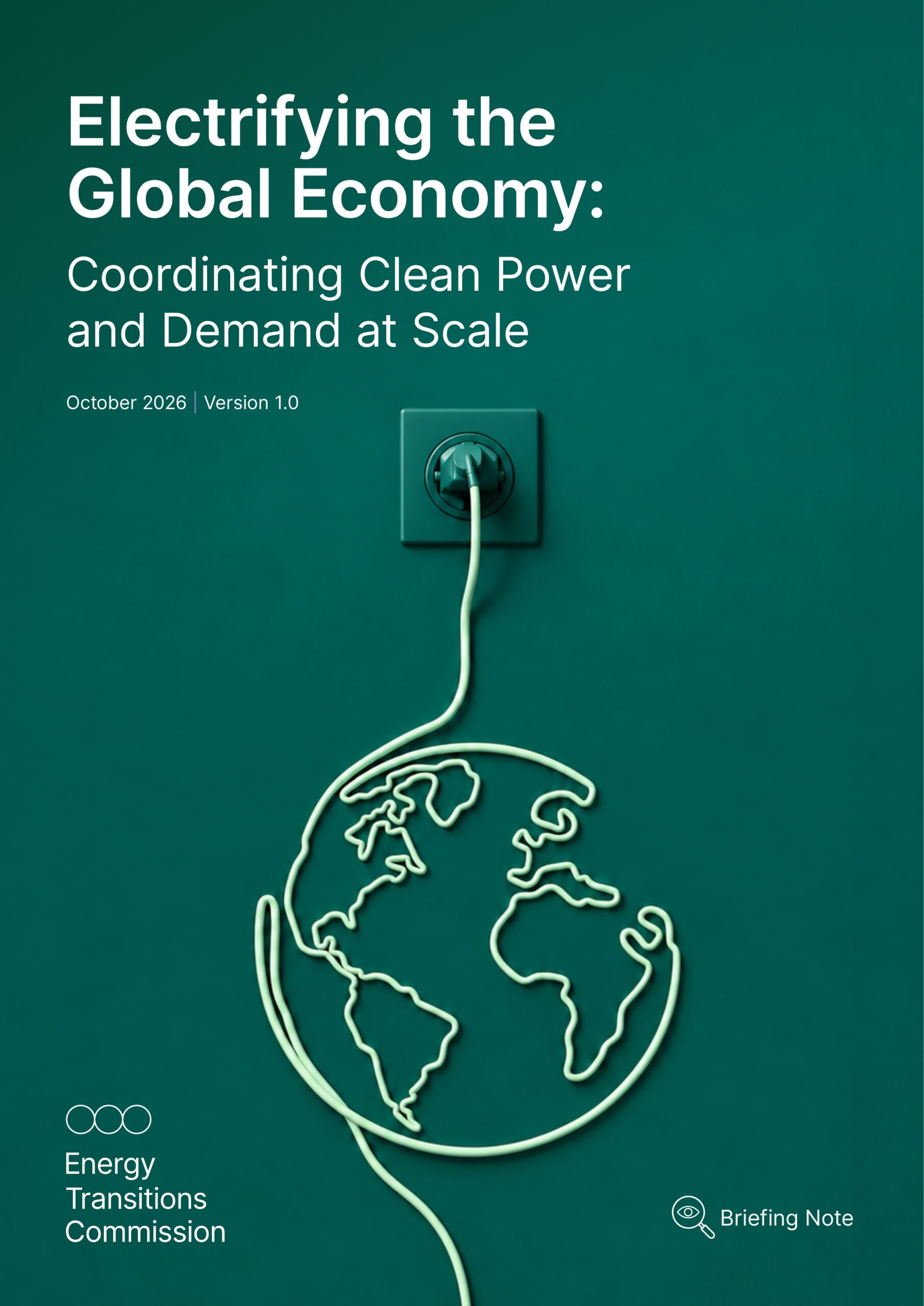
Electrifying the Global Economy: Coordinating Clean Power and Demand at Scale
October 2026
Clean electrification can cut around 60% of global greenhouse gas emissions at little or no extra cost. To deliver that, countries must scale clean power and electric demand together.
This Energy Transitions Commission briefing supports the global 35 by 35 target: raising electricity’s share of final energy demand from around 21% today to 35% by 2035. Five policy principles can get us there: a strategic electrification vision, modern infrastructure, fit-for-purpose market design, action on upfront costs, and stronger supply chains and skills. A new five-archetype framework matches each country’s policy priorities to its starting point.
Download
Scroll to explore the findings
How to electrify the global economy: matching clean power and electric demand, country by country
Why does electrification matter?
Switching from oil, coal and gas to clean electricity delivers five benefits every country needs.

Efficiency:
Electric motors and heat pumps are typically three times more efficient than the engines and boilers they replace. That shrinks the energy system needed to meet rising demand.

Lower costs:
Wind, solar and batteries are now cheaper than new fossil power in most regions. Costs fall as improvements learned from one technology feeds through to the others.

Energy security:
Around 75% of the world’s population lives in countries that import fossil fuels. Clean power, once built, is insulated from volatile fossil fuel price shocks.

Energy access:
Distributed solar is a low-cost route for energy access that can be installed without waiting for the grid to arrive.

Emissions reduction:
Clean electricity is the largest single route to cutting emissions, and produces no pollution at the point of use.
What is the single biggest way to reduce global emissions?
Clean electrification can cut around 60% of greenhouse gas emissions at little or no additional cost. The rest needs costlier solutions.
Greenhouse gas (GHG) emissions by sector (CO2, CH4, N2O, F-gases), annual average, 2020–2025
Gigatonnes of CO2 equivalent (GtCO2e)
~60
Tap or hover over each segment to explore the breakdown.
Physics favours electrification in most sectors
Heat pumps and electric vehicles need about a third of the energy that boilers and engines do. With clean power, switching cuts emissions at little or no cost.
Electrification alone cannot clean up heavy industry, aviation and shipping
Three limits hold it back. Some processes release CO2 through their chemical reactions. Some need chemicals, not heat, as an input. Long-distance aviation and shipping need fuels with a higher energy density than batteries can offer. Cutting these emissions needs other actions alongside clean electricity, such as material efficiency, recycling, clean hydrogen, sustainable fuels and carbon capture.
Biology limits electrification in food, land and waste
Agriculture, land use and waste emit nearly a quarter of the total. About 90% of that comes from livestock, soils and decomposing waste rather than burning fuel. The first priority is to cut them directly: end deforestation and reduce methane from farming and waste. Restoring forests and improving how land is farmed can also draw carbon back out of the air. Carbon removals have a role, but for emissions that cannot be cut.
Source: Systemiq analysis for the ETC; EDGAR (2025), Community GHG Database; ETC (2021), Keeping 1.5°C Alive.
The biggest cuts come from heat pumps replacing gas and oil boilers, electric cars replacing petrol and diesel cars, and electric heat replacing fossil fuels in industrial processes. About 60% of the identified savings rely on technologies already commercial today, from passenger EVs and urban buses to heat pumps in new buildings. The priority now is mass deployment.
Why must electrification and clean power scale together?
Clean power must keep pace with electrification to cut emissions
Clean power is electricity made from wind, solar, hydro, nuclear and other sources that do not burn fossil fuels.
If coal and gas generate electricity for new electric vehicles, heat pumps and industrial uses, emissions fall by less than they would on clean power. That is no reason to delay. Where the grid is on a credible path to clean up, switching to electricity remains the priority because the same cars, heat pumps and machines can run on clean power as the grid improves.
China: in 2025, new wind and solar met rising demand and coal power fell for the first time in a decade. In early 2026 grid bottlenecks left up to 10% of wind and solar unused, so coal filled the gap again. Clean power was built, but it could not reach the new demand, which capped the emissions cut.
Electrification must keep pace with the grid to keep electricity affordable
Electrification means switching from burning fossil fuels to using electricity to achieve the same outcome, such as driving a car or heating a home.
Network costs stay largely fixed however much electricity flows through them. If too few people switch from petrol cars and gas boilers to electric alternatives, each unit of electricity carries more of those costs. The price of electricity then becomes less competitive with gas, so fewer people switch, and prices stay high.
UK: in April 2026, a unit of electricity cost 4.3 times as much as a unit of gas, among the highest gaps in Europe. This makes heat pumps expensive to run, so fewer households switch. The grid cost is then shared across less electricity, which keeps prices high.
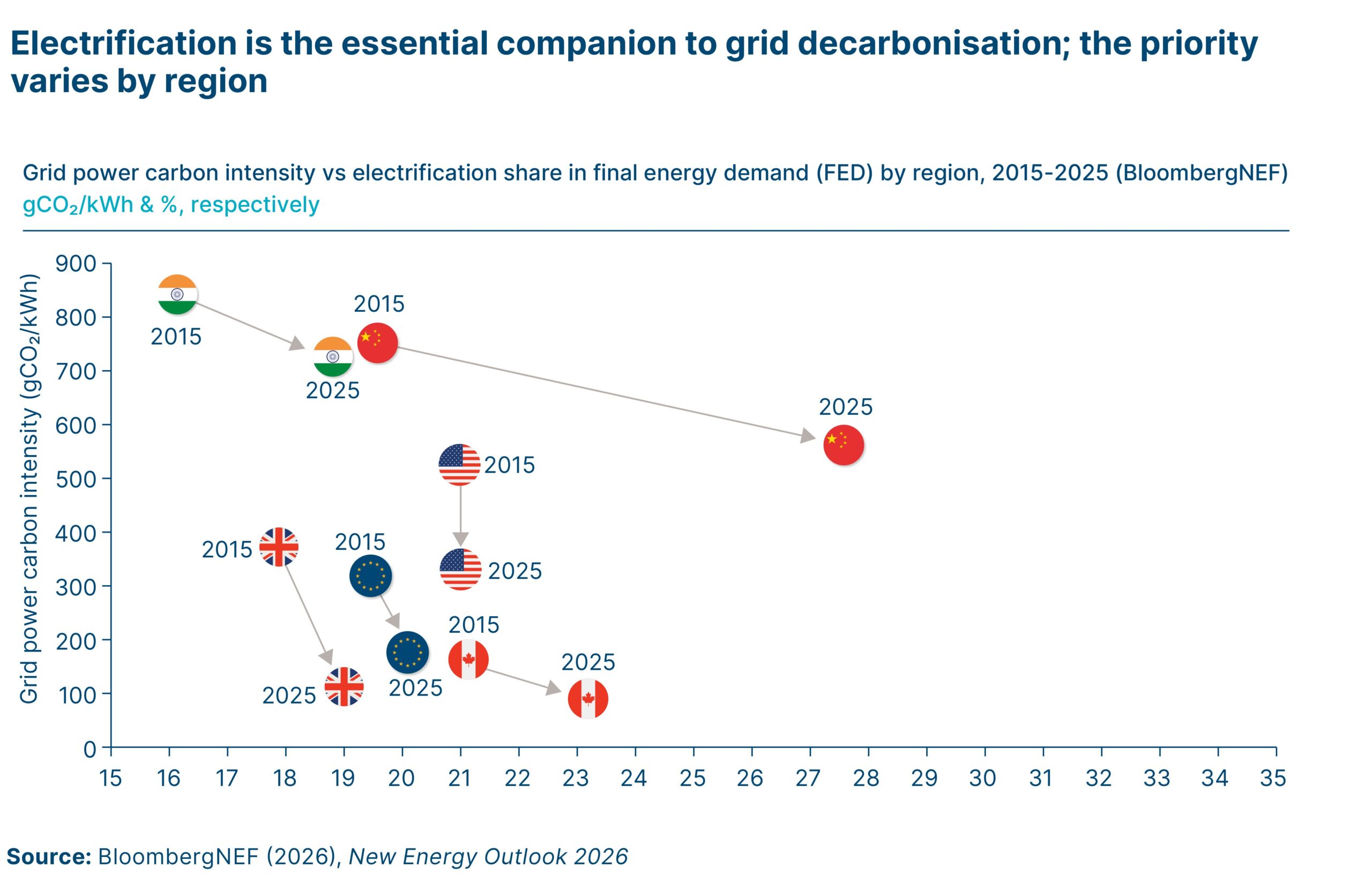
Countries are cleaning their grids and raising electricity’s share of energy use, but not always in step. When new demand outpaces clean supply, fossil plants fill the gap. When demand lags the grid, fixed costs fall on fewer users and prices rise. The chart above shows how uneven progress has been in the past decade. For example,
Between 2015 and 2025, China raised electricity’s share of final energy demand by around 8% to around 27%. The fastest rise of any major economy. Its grid also got cleaner, but at around 550 gCO₂/kWh it remains carbon-intensive.
In the same period, the United States, the United Kingdom and the European Union moved the other way. They cut grid emissions by between a third and more than half, yet their electricity share barely changed and still sits around 19% to 21%. Slow electricity uptake leaves network costs spread across too little demand.
Each country needs to push on the measure where it lags. When clean electric demand and supply grow together, every switch to an electric car or heat pump cuts more emissions and spreads grid costs across more electricity. Governments should plan clean power and electrification as one programme.
Does the same electrification policy work in every country?
Two priorities apply in every country: build clean power fast, and switch to the electric technologies that are ready today, such as electric vehicles and heat pumps.
The two priorities must grow together, because electric demand met by coal and gas saves far less carbon than demand met by wind and solar. The global 35 by 35 target, which would lift electricity’s share of final energy demand from around 21% today to 35% by 2035, gives every country a shared goal to work towards.
Each country starts from a different place, so each needs a different policy mix.
The ETC’s briefing groups countries into five archetypes. These are based on three measures: electricity’s share of final energy demand, the carbon intensity of the grid, and power demand growth from 2020 to 2025. Each archetype profile has a different first priority.
For example, countries with carbon-intensive grids, such as India, should scale clean power first while rolling out ready technologies such as EVs and electric buses.
Countries with cleaner grids, such as Germany, should turn to demand. That means heat pump and EV support, building codes and appliance standards, and rebalancing electricity and gas prices.
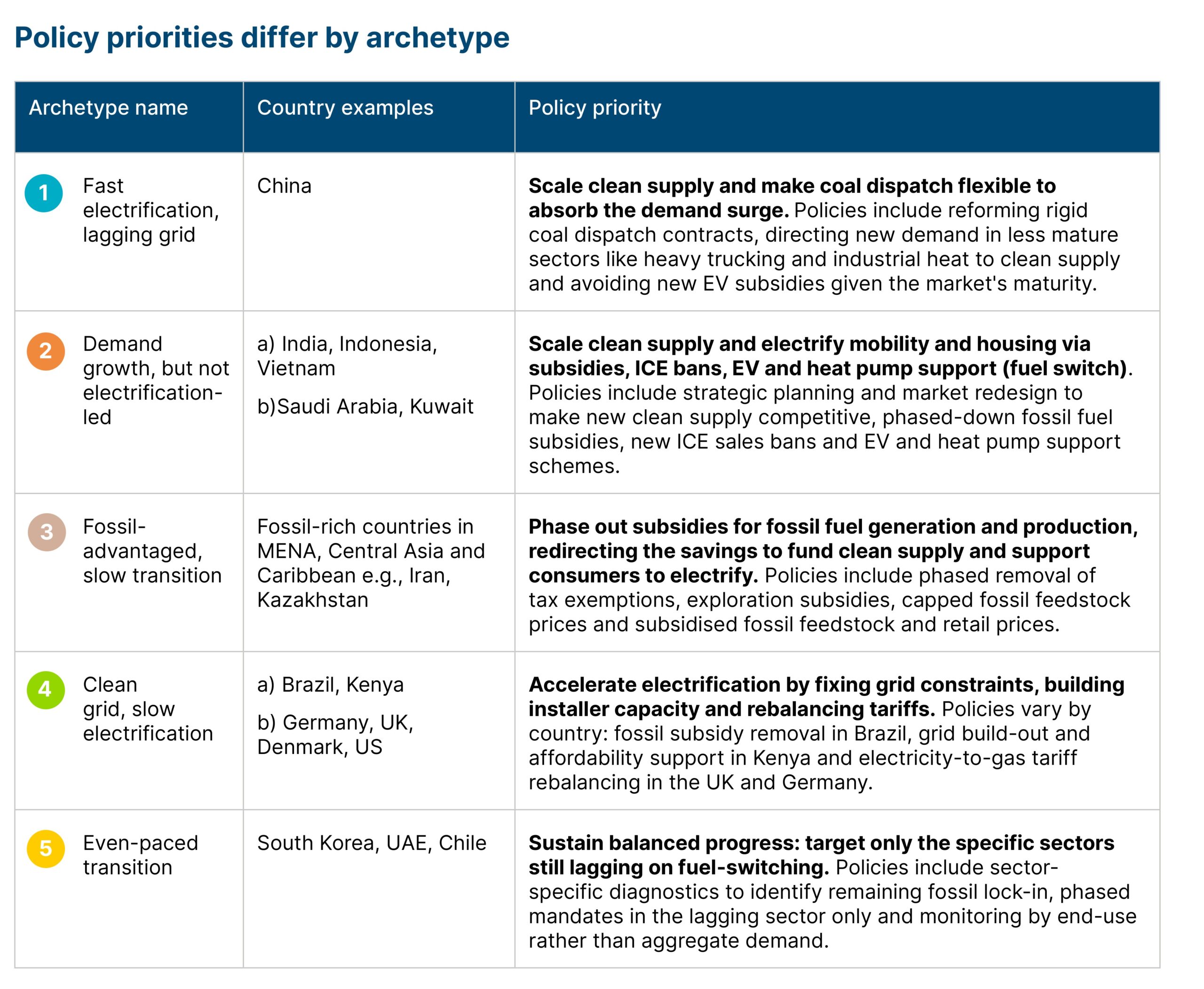
Electrification policy priorities differ by country

The COP31 Presidency’s 35 by 35 Global Electrification Pledge aims to raise electricity’s share of final energy demand from around 21% today to 35% by 2035. That means electrifying at roughly four times today’s rate. The technology works and costs are falling. What the world needs now is coordination and pace: faster clean power deployment, matched by faster uptake of electric vehicles, heat pumps and electric industrial heat. Each country should turn the global target into a national electrification pathway, coordinated with power sector decarbonisation, and prioritise the policies that fit its starting point.
Five policy principles can get us there: a strategic electrification vision, modern infrastructure, fit-for-purpose market design, action on upfront costs, and stronger supply chains and skills.
Related publications