


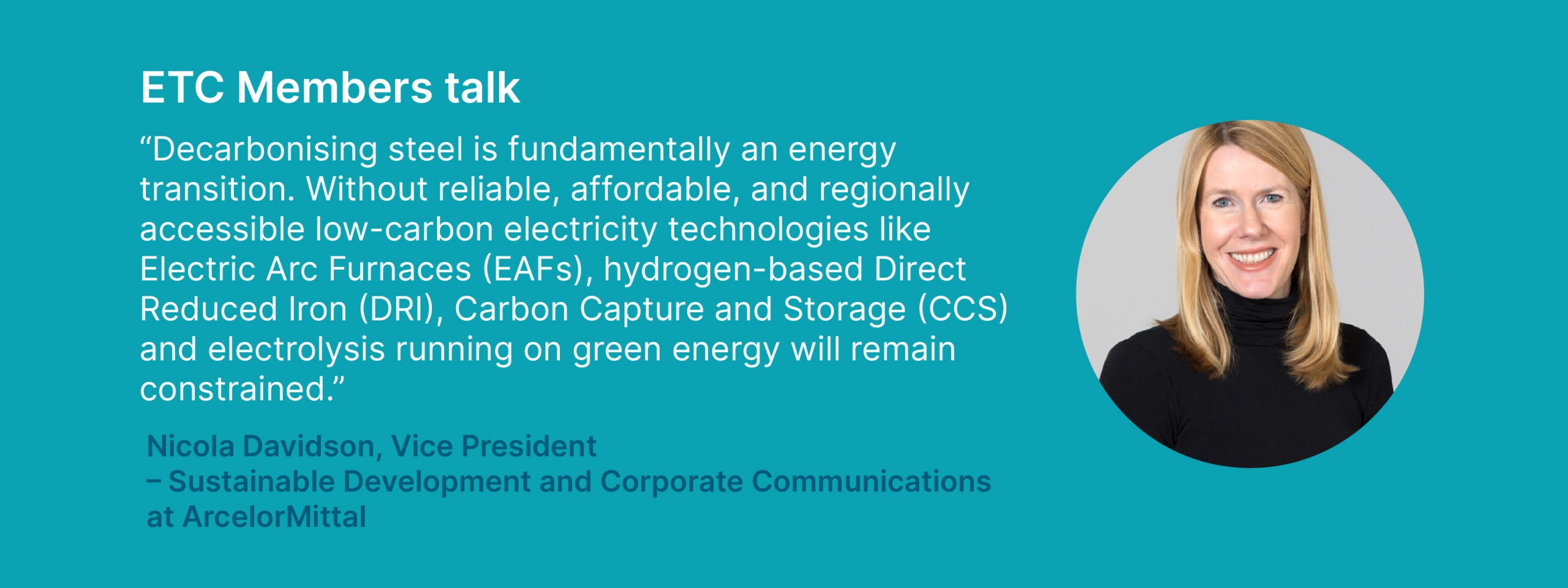
Get to know our members and what being part of the ETC means to them. We are pleased to share an exclusive interview with Nicola Davidson, Vice President – Sustainable Development and Corporate Communications at ArcelorMittal.
What drew your organisation to join the ETC?
We joined the ETC because we recognised the need for deep collaboration across sectors and geographies to tackle hard-to-abate emissions. The ETC brings together a unique coalition of organisations from diverse economic sectors, providing a platform for informed, constructive, and practical dialogue. The Commission’s highly technical and systemic approach was particularly compelling. We saw it as an opportunity to stay ahead of the curve in terms of our understanding of the energy transition’s challenges, help shape the decarbonisation agenda, and ensure the steel sector plays a constructive and proactive role, considering that a net-zero economy will be underpinned by steel.
What do you see as the ETC’s most impactful achievement since you’ve been a Commissioner?
The ETC has had several standout contributions, but I would highlight its work of the Mission Possible Partnership sectoral deep dives, particularly the work done on steel and other heavy industry sectors. These reports helped shift the narrative from “if” to “how” net-zero would be possible. We don’t always agree on every little detail but without a doubt they have helped bring attention to the significant challenges the sector faces to decarbonise.
What do you see as the biggest obstacle on the journey to net-zero?
Decarbonisation in the steel sector has also proven complex and non-linear, requiring a balance of economic viability, technological readiness, and supportive policies. In many regions there is little to no economic rationale for companies to decarbonise, as making low-carbon emissions steel is considerably more expensive than higher-emitting steel.
Companies like ours operate within frameworks shaped by regulation, infrastructure, technology availability, and demand signals. Without aligned and supportive policies, it becomes increasingly difficult for even the most committed companies to reduce emissions at the necessary pace and scale.
So the challenge isn’t about a lack of viable technologies; we know what many of the solutions are. The real obstacle is the systemic transformation needed to create an enabling environment that unlocks industrial decarbonisation globally.
What are the key milestones you see on the road to net-zero, and why?
Transitions often appear slow, until they reach a tipping point. Just as blast furnaces reshaped the industry 70 years ago, and as we’ve seen with renewables and electric vehicles more recently, transformative shifts can accelerate rapidly once enabling conditions align. For steel, reaching that tipping point in low-carbon emissions production will depend on a few critical milestones in the coming decades:
- Scale-up of clean, affordable electricity: Decarbonising steel is fundamentally an energy transition. Without reliable, affordable, and regionally accessible low-carbon electricity technologies like Electric Arc Furnaces (EAFs), hydrogen-based Direct Reduced Iron (DRI), Carbon Capture and Storage (CCS) and electrolysis running on green energy will remain constrained.
- Mature demand for low-emissions steel: Strong demand signals, from private and public procurement, are essential. When this demand is backed by a willingness to pay a green premium, it helps offset higher production costs and de-risk investment in low-carbon assets.
- Robust and aligned policy frameworks: Policy has a critical role to play in supporting investment in lower-carbon emissions steelmaking assets and technologies. Well-designed policies can create a level playing field, encourage investment while preventing carbon leakage to regions with weaker climate regulations.
What is the one necessary change you feel most personally passionate about in the transition journey?
That the value of green steel is recognized by our customers.