

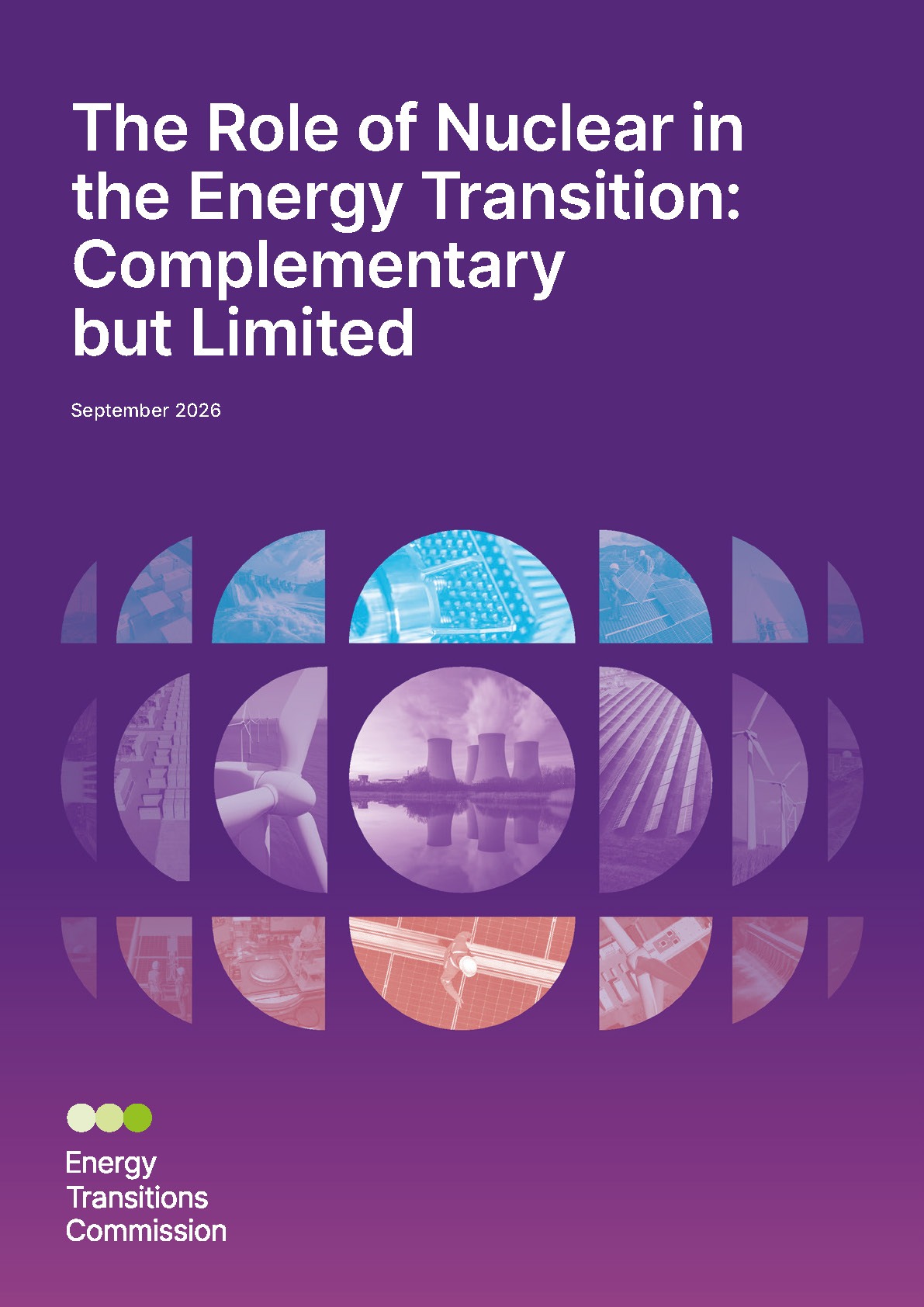
The Role of Nuclear in the Energy Transition: Complementary but Limited
October 2026
Nuclear power will play a role in decarbonising energy systems, but a more modest one than some assessments assume. The Energy Transitions Commission’s report examines where nuclear makes economic sense and where it does not.
The analysis is clear on costs. In China, South Korea and India, new nuclear plants deliver electricity at under $50 per MWh. In Europe and the US, comparable plants cost $150 per MWh or more—substantially higher than solar and onshore wind. In solar-rich regions, the gap widens further.
Local construction costs, financing rates, and project timelines also vary significantly across regions. Countries with low-cost capital and established supply chains can deliver nuclear competitively. Others cannot.
This informs nuclear’s realistic role. In some power systems, nuclear can reduce total system costs by providing firm capacity for grid balancing at generation shares of 10–20%. This advantage applies mainly where renewable resources are constrained or grid infrastructure is limited. There is no universal case for nuclear. Its role must be determined by each country’s renewable potential, grid infrastructure, and capital costs.
Globally, nuclear capacity could increase from 400 GW today to 750 GW by 2050. This requires at least tripling annual build rates to 15–25 GW per year. Achieving this target demands sustained investment alongside far larger expansions in renewable capacity and storage.
Download
Related publications